
Understanding physical and transitional risks and opportunities
As climate change awareness and concern continues to increase throughout the world, beverage companies are proactively driving strategies to reduce the greenhouse gas emissions (GHG) associated with their enterprises as well as the life-cycles of their products. Through the allied voice of BIER, members collaborate to monitor and adapt to changing physical and transitional conditions and climate scenarios in alignment with the Task Force on Climate-Related Financial Disclosures (TCFD). This combination of decarbonizing operations and adapting to external conditions drives BIER’s work on common practices for calculating, tracking, benchmarking, managing, and reporting decarbonization and climate change adaptation within the beverage sector.
Climate Change Risk Briefs
The following briefs are intended to build capacity and a more practical understanding of select TCFD risk categories, opportunities, and potential business impacts.
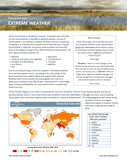 Physical Risk Brief: Extreme Weather
A weather event that falls outside normal pattern is classified as extreme weather. Outside of normal patterns are defined as weather conditions that are unseasonal, unexpected, or intensity that’s outside of local historical norm. Though the threshold is subjective, commonly, extreme events are those that occur in the highest or lowest 5% or 10% of historical measurements.
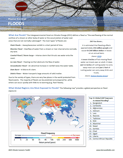 Physical Risk Brief: Floods
The Intergovernmental Panel on Climate Change (IPCC) defines a flood as “the overflowing of the normal confines of a stream or other body of water or the accumulation of water over areas that are not normally submerged”. There are many different types of floods and due to the variety of types, there are very few places in the world protected from flood events. The majority of floods can be predicted and prepared for, while others can occur quickly with little to no warning (e.g. flash floods).
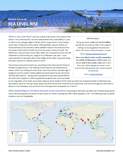 Physical Risk Brief: Sea Level Rise
Like the surface of the earth, the surface of the ocean is not uniformly flat. The term Global Mean Sea Level (GMSL) is used to refer to the average height of all the Earth’s ocean basins. Since oceans cover about 70 percent of the world, defining GMSL requires millions of measurements to be recorded. The primary cause of sea level rise, according to the International Panel on Climate Change (IPCC), is the melting of the Antarctic and Greenland ice sheets, which are melting six times faster than they did four decades ago.
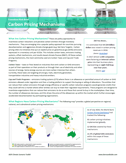 Transition Risk Brief: Carbon Pricing Mechanisms
These are policy approaches to incentivize carbon reductions and penalize carbon emitters through monetary mechanisms. They are emerging into a popular policy approach for countries pursuing decarbonization and aggressive climate change goals (e.g. Net Zero Targets). Carbon pricing refers to initiatives that put an explicit price on greenhouse gas (GHG) emissions expressed in a monetary unit per tCO2e. This includes carbon taxes, emissions trading systems, offset mechanisms, and results-based climate finance (RBCF).
Additional Climate Change Work Products
The following publications relate to our efforts in improving energy efficiency and forming climate change solutions within the beverage sector.
- BIER’s Joint Commitment on Climate Change: Read the full text of the commitment BIER members have made to do their part to actively fight climate change.
- NEW Beverage Industry Sector Guidance for Greenhouse Gas Emissions Reporting aimed to enhance and support the estimation, tracking and reporting of GHG emissions within the beverage industry.
- BIER’s Future Scenarios Planning Toolkit
Plus in-depth carbon footprint research by beverage category:

BIER Unveils Version 4.3 of Beverage Industry GHG Emissions Sector Guidance
The Beverage Industry Environmental Roundtable (BIER) proudly announces the release of Version 4.3 of its groundbreaking Beverage Industry Greenhouse Gas (GHG) Emissions Sector Guidance. This latest iteration is designed to further support the beverage industry in aligning with global GHG reporting protocols while enhancing consistency, accuracy, and leadership in emissions calculation and reporting.
The Beverage Industry Environmental Roundtable (BIER) Issues Results of 2021 Water, Energy, and Greenhouse Gas Emissions Benchmarking Study
The Beverage Industry Environmental Roundtable (BIER) completed its 11th global benchmarking study – a comprehensive quantitative and qualitative research of water, energy, and emissions efficiency in the beverage industry. The findings of the study substantiate the beverage industry’s ongoing efforts to better understand and reduce resource use on a global scale.
The Beverage Industry Environmental Roundtable (BIER) Releases The Facility Decarbonization Playbook
In response to a world progressively seeking to move towards low carbon economies, the Beverage Industry Environmental Roundtable (BIER) has published The Facility Decarbonization Playbook.

Introducing BIER’s 2024 Water Circularity Playbook: A Guide to Implementing Circular Water Solutions
The Beverage Industry Environmental Roundtable (BIER) is proud to announce the release of the BIER Water Circularity Playbook, a comprehensive guide designed to help organizations prioritize water risks and implement effective circular water solutions.

Spring Forward: BIER’s Collective Progress on Climate, Water, and Circularity
Spending summertime outdoors, near lakes and streams, or hiking in nature, naturally brings environmental issues to the forefront. The Beverage Industry Environmental Roundtable (BIER) addresses several critical areas, particularly water, energy, and climate, which are crucial for preserving these natural landscapes.
The Beverage Industry Environmental Roundtable (BIER) Issues Results of 2023 Water, Energy, and Greenhouse Gas Emissions Benchmarking Study
The Beverage Industry Environmental Roundtable (BIER) completed its 12th global benchmarking study – a comprehensive quantitative and qualitative analysis of water, energy, and emissions efficiency in the beverage industry.
The Beverage Industry Environmental Roundtable Issues Internal Carbon Pricing – An Implementation Guide for Beverage Companies
The Beverage Industry Environmental Roundtable (BIER) developed this guide to better understand how Internal Carbon Pricing (ICP) can be a useful tool in a company’s decarbonization journey.

The Beverage Industry Environmental Roundtable (BIER) Releases Latest Greenhouse Gas (GHG) Emissions Sector Guidance
The Beverage Industry Environmental Roundtable (BIER) has made further enhancements and additions to the Beverage Industry Greenhouse Gas (GHG) Emissions Sector Guidance (4.1) published in July 2019.

The Beverage Industry Environmental Roundtable (BIER) Releases The Decarbonization Playbook for Small and Medium Suppliers
In response to a world progressively seeking to move towards low carbon economies, the Beverage Industry Environmental Roundtable (BIER) has published The Decarbonization Playbook for Small and Medium Suppliers.

Climate Change & Scenarios
As climate change legislation advances throughout the world, beverage companies are proactively driving strategies to reduce the greenhouse gas emissions associated with their enterprises as well as the life-cycles of their products. Through the allied voice of BIER, members collaborate…